Hello again! It's Fall Conference time here in NH!
I have been going to the New Hampshire Art Educators' Association (NHAEA) Fall Conference since 2011 and really love it. It's a great opportunity to connect with other educators in the state and they always offer so many wonderful sessions.
I am the newsletter editor for the NHAEA and here's the Fall Newsletter which has the conference information. This year's conference theme is "Champions of Constructive Change." I know some of my followers live too far away to attend, but if you live near Southern NH (the conference is in Manchester, NH), think about attending! Also, check out the newsletter and see what we are up to in NH!
Enjoy!
Showing posts with label conference. Show all posts
Showing posts with label conference. Show all posts
Saturday, September 9, 2017

Thursday, October 27, 2016
NH Art Educator's Fall Conference 2016!!
The New Hampshire Art Educators Association's (NHAEA) Fall Conference is one that I look forward to every year--"Clear the calendar! My Conference is coming up!!!" I love to connect with old friends, meet new friends, enjoy a lunch that is made for me and that I don't have to clean up after (hey, I do have four kids!), and get my artsy-ness on!! I purposely sign up for hands-on art making workshop choices. While I love me some lecture on art education theory, I don't get to make art as much as I would like, and art school was a-ways back in time, so any chance I have to create and learn new things I can take back to my classroom, I am game!
This year's conference was fabulous and inspiring! It was held at the New Hampshire Institute of Art (NHIA) in Manchester, NH. Keynote speaker NH Artist/Illustrator/Author Marty Kelly spoke about his artistic process and how his multiple "failures" have been useful to his creative process. He urged us as educators to create a "culture of failure" in our classrooms where it is OK to make mistakes and take chances (leading students to further growth, risk-taking, exploration). He suggests that failure is part of the learning process and is essential to learning and growth. He encouraged us to change our attitude about failure as well as our students' attitudes about it as well. He explained that if we are afraid to fail we will be afraid to imagine, innovate, explore, and try. Having a classroom culture where failure is accepted and seen as an opportunity for discussion and growth also allows students to begin to accept advice and criticism and use what is right for them. He says that failure is a "pit stop along the road to success."
This is particularly useful to me as much of what we do in the middle school art room is moving away from product-focused, cookie cutter art to process-focused, student-centered work where the students are encouraged to problem-solve, explore and make the piece their own. This is a tough transition for some and some students struggle when they do not have a teacher-model to "copy" and are asked to try and explore and adapt. I've often have students come up and ask, "Is this an A? Am I done?" The first couple of times this happened I was floored, now I counter with: "I don't know, are you done? Take a look at the project objectives and talk to one of the other students in class to see if they have suggestions for further improvement (or to see if your piece is "saying" what you want it to say)." To me, this part of the creative process is a gradual release as the students' confidence and skill-level increases, ultimately preparing them for the independence and self motivation that high school will require.
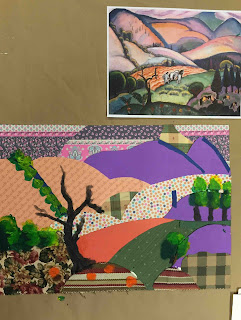
Session 1: Reinterpreting With Recylables. I went on a mini field trip to the Currier Museum of Art and saw the Mount Washington show that just opened. Mount Washington is the highest mountain in New Hampshire and is known throughout the world for its crazy weather. We went downstairs to classroom and Linn Krikorian taught us how we can use the art and artifacts within the Currier's collection as well as from life and other disciplines and have students reimagine them using recycled materials. Resources were shared for places to get interesting recyclables and for using this idea across the curriculum. Then Megan McIntyre discussed how art can be used to facilitate other ideas across the curriculum such as Science, Math, etc. This is particularly pertinent to me in my art room as I strive to develop lessons that are individualized and cross-curricular in nature. This lesson idea (and its spin-off ideas) will be helpful to me as I encourage the students to observe and reinterpret art and artifacts in class but make them their own.
Session 2: Structures to Sculpture (Bookmaking) This was a wonderful hands-on session led by Erin Sweeney, professor at NHIA (and her student helper Karen) taught us about a number of book-making techniques and led an open discussion amongst the creative educators present as to how we are currently using these structures within our classrooms and how we could potentially use them even more. Connections to other courses were discussed as well as connections to STEM/STEAM. While the pieces we made weren't complete (just the "bones" of the books and not fully developed within), the examples took the 2D linear idea of "book" and transformed it into 3D sculptural forms (easily!!) that could be used in our teaching in a number of ways (assessment, reflection, student mini portfolios, the documentation of a unit or the transformation of an idea, etc.). This was a VERY relevant workshop in that it allows a student to move from 2D to 3D in a seamless and accessible way while allowing them to reflect on a process or subject matter and use the 3D model-making techniques that we strive to teach them in class. This will definitely be applied to my future 7th and 8th grade classes next trimester!
After our sessions, we met back in the mail hall for closing remarks, a raffle (nope, didn't win anything this year), and a wine a cheese reception sponsored by NHIA. I went away physically tired, but rejuvenated and with so many great ideas that I can bring back to my students!
And here are some other images from the Currier workshop--the art of my classmates. ENJOY!




 |
| Interacting with the art at the Currier Museum... |
This year's conference was fabulous and inspiring! It was held at the New Hampshire Institute of Art (NHIA) in Manchester, NH. Keynote speaker NH Artist/Illustrator/Author Marty Kelly spoke about his artistic process and how his multiple "failures" have been useful to his creative process. He urged us as educators to create a "culture of failure" in our classrooms where it is OK to make mistakes and take chances (leading students to further growth, risk-taking, exploration). He suggests that failure is part of the learning process and is essential to learning and growth. He encouraged us to change our attitude about failure as well as our students' attitudes about it as well. He explained that if we are afraid to fail we will be afraid to imagine, innovate, explore, and try. Having a classroom culture where failure is accepted and seen as an opportunity for discussion and growth also allows students to begin to accept advice and criticism and use what is right for them. He says that failure is a "pit stop along the road to success."
 |
| Keynote Speaker: Author and Illustrator Marty Kelly Photo courtesy: NHAEA website (www.NHAEA.org). |
Session 1: Reinterpreting With Recylables. I went on a mini field trip to the Currier Museum of Art and saw the Mount Washington show that just opened. Mount Washington is the highest mountain in New Hampshire and is known throughout the world for its crazy weather. We went downstairs to classroom and Linn Krikorian taught us how we can use the art and artifacts within the Currier's collection as well as from life and other disciplines and have students reimagine them using recycled materials. Resources were shared for places to get interesting recyclables and for using this idea across the curriculum. Then Megan McIntyre discussed how art can be used to facilitate other ideas across the curriculum such as Science, Math, etc. This is particularly pertinent to me in my art room as I strive to develop lessons that are individualized and cross-curricular in nature. This lesson idea (and its spin-off ideas) will be helpful to me as I encourage the students to observe and reinterpret art and artifacts in class but make them their own.
 |
| My take on a Robert Indiana from the Currier's collection. |
Session 2: Structures to Sculpture (Bookmaking) This was a wonderful hands-on session led by Erin Sweeney, professor at NHIA (and her student helper Karen) taught us about a number of book-making techniques and led an open discussion amongst the creative educators present as to how we are currently using these structures within our classrooms and how we could potentially use them even more. Connections to other courses were discussed as well as connections to STEM/STEAM. While the pieces we made weren't complete (just the "bones" of the books and not fully developed within), the examples took the 2D linear idea of "book" and transformed it into 3D sculptural forms (easily!!) that could be used in our teaching in a number of ways (assessment, reflection, student mini portfolios, the documentation of a unit or the transformation of an idea, etc.). This was a VERY relevant workshop in that it allows a student to move from 2D to 3D in a seamless and accessible way while allowing them to reflect on a process or subject matter and use the 3D model-making techniques that we strive to teach them in class. This will definitely be applied to my future 7th and 8th grade classes next trimester!
 |
| Busily working at the Structures To Sculpture Session led by Erin Sweeney. Photo courtesy: NHAEA website (www.NHAEA.org). |
And here are some other images from the Currier workshop--the art of my classmates. ENJOY!


Wednesday, May 4, 2016
My memories from Chicago: The 2016 NAEA Conference
OK, so this trip of mine was taken in March, but I thought I'd post some picts anyway...what a great time I had! I hadn't flown in 15 years and this was my first trip (over 24 hours) away from my kiddos. My hubby also decided to get me a new phone on the way to the airport. That may not seem significant to you, but my old phone was probably 10 years old and wasn't smart at all! ;-) Anyhow, I took TONS of photos, but here are the highlights:
Starting at the top left:
 |
| This COOL-age was made using be funky--I just LOVE it! |
- Getting to see some inspiring contemporary art at the Chicago Cultural Center
- Meeting one of my favorite bloggers, Cassie Stephens--and her friend Jennifer Alvarado (both ladies were so sweet and gracious).
- Finding a Chihuly piece by accident
- Finding a Calder piece by accident (actually they weren't technically by accident since I had checked out this site before going).
- Finding TWO cows! You know I love them!
- Falling in love with a new-to-me painting by van Gogh at the Art Institute.
- Seeing van Gogh's palette.
- Getting up close and personal with A TON of wonderful artists (again, at the Institute).
- Having a Chicago Dog!!
- Talking to Cloud Gate on the phone (http://statuestorieschicago.com)
- Getting up close and person with Straandbeasts and taking one for a walk at the Chicago Cultural Center (see link above).
- Seeing all sorts of neat signs and window displays
- Making discoveries and exploring (window in the Cultural Center)
And the larger, central image is the view from the bar at the Chicago Athletic Hotel. I should have taken a photo of the bar--it was GORGEOUS!
Oh, and there was a conference, too! I had a great time at the conference chatting with other educators, checking out the vendors, and learning all sorts of great things--some of which I began using THE DAY I GOT BACK. I've made a little "scrapbook"-type thing that hold images, notes, etc. from the trip and I have referred to it many times since my return to access handouts and notes from the sessions I attended.
What a great experience!
Thursday, January 21, 2016
"This is Our Story:" An Intro to Digital Storytelling
I'm so excited to be be co-leading a session at the Integrated Arts Conference at Plymouth State University. My colleague, Tiffany Dube, and I will be talking about Digital Storytelling. Tiffany is sharing a bunch of (mostly) free and fabulous tools educators can use with their students to create comic strips, audio files, books and more. I am going to talk about using stop motion animation and give attendees some time to play around with a couple different APPs I've used with students. It should be fun!
Here's the Thinglink clickable image I've created with all of our resources and links--check it out!

Here's the Thinglink clickable image I've created with all of our resources and links--check it out!
Wednesday, January 21, 2015
Integrating the Arts and Technology: A Few of OUR Favorite Things!
 "Touch this image!"
That's the phrase Thinglink uses whenever someone shares a clickable image created using this amazing website! Try our Thinglink image above entitled "Integrating With Technology: A Few of OUR Favorite Things" and leave a comment at the bottom of this post with any ideas YOU come up with for integrating this piece of technology in your classroom!!
What's Going On Here?
Well, this image contains all of the resources and links for a conference session I am leading with my colleague, Tiffany Dube. We placed this image here so that participants could access it easily. You get to see it too! We structured our session to be an exploration of tech tools by having participants use a choice board. No matter how YOU learn (or what type of art you are trying to integrate), there's a tech tool for that!
About www.Thinglink.com:
Thinglink allows you to upload an image (from the web or from your desktop) and add clickable "tags" to it. These tags can be text, videos, or websites. The sky's the limit for this resource! Use it to flip your classroom, organize a presentation, have students create one for a project (either by themselves or as a group). You can sign up for a free thinglink account. Also, check out their website and click the "browse" tab to see how others are using this resource.
I do not receive any compensation from Thinglink for posts like this. I just use it myself and think others would like to as well! :-)
Friday, January 24, 2014
The Heart Needs ART!
I just got home from a wonderful conference at Plymouth State University on Integrating the Arts. So awesome! I met a ton of great educators. You'll be hearing more about my findings from the conference soon since I'm taking a related course for Grad credit. Now I need to come up with a project that integrates the arts with other subjects in the curriculum...now, if you're like me, I can't teach a lesson without tripping over a dozen standards! So hopefully this integrated arts project will be fun to create!
One thing we did to wrap up the conference was that we each created a "quilt square" from a variety of media that represented something we learned at the conference. Here's mine:

It's a positive/negative space Notan that is meant to show how the arts are related and connected to one another (theater, visual arts, music & dance) and the top triangle represents one of my loves: New Hampshire! It's supposed to depict the mountains of NH--hey, I only had about 15 minutes or so! Maybe I could go as far as to say the top triangle represents the NH Common Core Standards!?! See how the Common Core standards are connected to the Arts? Man, I'm good!
But really, this image is based on something one presenter said: "New Hampshire has a long-standing tradition of a love for the arts!" And another presenter said "The Heart Needs ART!"
I'm happy to be a part such a great profession!
FYI: the quilt squares made by the conference-goers were complied into a larger paper quilt that was displayed at the performing arts center at PSU. What a great idea, huh? Having everyone create a bit of art to get them thinking about what they learned during the day. It was great to see how different all of the squares were.
So make your heart happy--and do some ART!
One thing we did to wrap up the conference was that we each created a "quilt square" from a variety of media that represented something we learned at the conference. Here's mine:
It's a positive/negative space Notan that is meant to show how the arts are related and connected to one another (theater, visual arts, music & dance) and the top triangle represents one of my loves: New Hampshire! It's supposed to depict the mountains of NH--hey, I only had about 15 minutes or so! Maybe I could go as far as to say the top triangle represents the NH Common Core Standards!?! See how the Common Core standards are connected to the Arts? Man, I'm good!
But really, this image is based on something one presenter said: "New Hampshire has a long-standing tradition of a love for the arts!" And another presenter said "The Heart Needs ART!"
I'm happy to be a part such a great profession!
FYI: the quilt squares made by the conference-goers were complied into a larger paper quilt that was displayed at the performing arts center at PSU. What a great idea, huh? Having everyone create a bit of art to get them thinking about what they learned during the day. It was great to see how different all of the squares were.
So make your heart happy--and do some ART!
 |
| The 2014 AIC Reflection Quilt |
Wednesday, January 22, 2014
Another Artsy Conference Coming Up...Even for the non-artsy!
If you are looking for a scenic drive up to Plymouth, NH this Friday as well as some professional time, try this Conference...


The Integrated Arts Conference is going to be held this Friday in Plymouth, NH at the Plymouth State University campus. The sessions look intriguing and I can't wait to check them out!
Here's the schedule for the conference:
And while you are there, check out Oliver! at the Silver Center (the conference is centered around this classic play).
And as for places to eat...Thai Smile on Main Street is a great choice! YUM!
See you there!
Wednesday, December 4, 2013
Ten Things This Art Teacher Learned From a Tech Conference
Yesterday I attended one day of the Christa McAuliffe Technology Conference in Manchester, NH. I was lucky enough to have recived a one day scholarship to the event and I joined one of my colleagues from Plymouth State University and five Undergrads from Plymouth's Department of Elementary Education & Childhood Studies for a day of technological fun!
A bit of info about the conference:
From the nhcmtc.org site: "Christa McAuliffe was our New Hampshire "teacher in space" astronaut who died in the Challenger shuttle launch on January 28th, 1986.
In Christa's memory and in keeping with her spirit this conference is designed to highlight the sharing of successful technology practices among educators. The conference serves as a forum for exchanging technology-based success stories, integration tips, instructional strategies, technical solutions, and management techniques, that really work in the learning environment."
 |
| Christa McAuliffe Experiences Weightlessness During KC-135 Flight (image from wikipedia) |
A bit of info about technology and me:
OK, so, I have to tell you--I'm not techy. I mean, I have to have my 11-year-old do all the tech work on my iPad, computer, and cell phone (which isn't even a Smartphone!). SIGH. But I'm learning! I attended so that I could learn how to include technology in my classroom as well as help the Undergrad students I work with at Plymouth State incorporate technology into their lessons.
But I have to say, I was a bit nervous about attending this conference. I'm not sure why--it isn't as though someone was going to stop me and ask me to reprogram their computer or something!
So here are the Top 10 things This Art Teacher Learned From a Tech Conference:
10. I'm not alone. Look, I cannot even get my remote start on my van to work (I stand outside the car door clicking the switch and locking and relocking the car over and over). And I don't run into many artists and art teachers during my day. But, I was surprised when the keynote speaker for the day, Kevin Honeycutt (Hi Kevin!), started off his lively presentation by sharing that for thirteen years, he was an art teacher! This conference is for educators, no matter what they teach! Not only was I not the only art teacher in attendance, I was surrounded by other educators who want to find a way to include technology in their lessons. If I want to make sure art is kept in the schools--I need to make sure I'm at as much stuff as possible, talking with people, sharing ideas, and KNOWING that all subjects need art to bring it all together!
9. Don't wait until you're perfect. This one is also from Kevin Honeycutt. Imagine if people didn't do anything unless they'd be perfect right away! Is that what I teach my students? Is that what I teach my own kids? NOPE! I cringe at the first posts on my blog and I still drool over blogs where people have professional-looking photos, but I'm here and sharing my stuff. I didn't wait until I had made tons of claymation movies to teach a class on animation--I fooled around for a few seconds with the program, showed my students a couple of short animations, and then set my kids loose on it! They taught me and taught each other. Seriously, if I wait until I KNOW what I'm doing, I'll be left behind. I can always ask a student to teach me! :-)
8. Keep track of what's important to you. Kevin Honeycutt might check out this blogpost. Am I so cool that a person with 21,000 Twitter followers would check out my humble blog? No, but he uses Google Alerts to track the things on the web that are important to him. So, whenever anyone mentions his name, his son's name, etc., he's receiving an alert. I could do this if I was interested in claymation, or 3D printing, or iPads in the art classroom. I'll have to experiment to make sure I'm not receiving a million unnecessary emails, but I could always do alerts on myself and my school. Let's see what people are saying.
7. Every student is a person. Again, thanks, Kevin. I mean, I KNOW that the students I teach are people, obviously, but am I really treating them--all of them--with respect and showing them that I am glad they are in my class (I think so, but now I'm going to be watching). How am I reacting to students? Even the little things make a difference. If I sigh whenever a student asks me a question or don't try to reach a student who just sits there, head down, I may be missing out. What if I am the only one who ever shows a student that have worth, just by being who they are? This works with my own kids too.
6. If I wanted an easy job (and wanted to be rich)--I shouldn't have chosen teaching. This teaching business is a lot of work, both in and out, of the classroom--YOU KNOW THAT. And even when I am done my degree, I'm not done learning. It isn't like I think of 100 lessons and I teach those until I retire. Every day I am going to be thinking and changing and learning something new for myself and my students. But if I want to teach my students to be lifelong learners, I need to model that!
5. You need to make time to try technology, but you don't have to do it alone. Kathy and Laura from Antioch University spoke about that. There's a lot of technology out there. It's overwhelming, I know. But, baby steps! I need to talk to others, see what they've tried, try a few APPs, websites, and programs and share what I've learned. I can also have the students review things and share their findings--I don't have to go it alone! I can ask for help!
4. We need to teach students HOW to behave on their "digital playgrounds" and be open to change. I know students are using technology, but it can be used for so much more that social media! They know how to use the devices, but I'm going to teach them how to use these devices for so much more! Think of all the teachable moments that will arise when students are experiencing this new way of working. Those teachable moments can BE the lesson! Also, I need to not be so worried about what software or APPs I'm using, APPs come and go, what I am teaching my students is bigger--how to be LEARNERS, no matter what the tools.
3. Make it relevant for the students--projects and technology can help! Kathleen McClaskey from Ed Tech Assoc. spoke about that. I'm trying to give my students more choice--I know, it's scary! But when I personalize learning to the students, I allow them to make the learning relevant to them and take ownership of their learning. I'm starting small by having students choose the subject matter (while I choose the media) and vise versa! Also making technology one of the tool choices in a project or two. Some students won't choose it, but some will--maybe even those students who "don't like art."
2. Grad credit can be found in surprising places! Ok, so this one may not interest you, but it was pretty neat to me! As I've said before, I'm going to Grad school at Plymouth State University. At this conference, I noticed THREE different ways to earn grad credit--just for learning things I wanted to know already! If you decide to go back to school, check out the options your school offers for alternative options for earning credits--you can customize your learning to suit your needs and interests. Thank you PSU!
1. There's so much to learn! And learning can be fun! Attitude, attitude, attitude! Do I want my students to be overwhelmed by all of the stuff they need to know? Trust me, some of them are already! And sometimes I feel this way about all the stuff I need to know to include technology in my classroom. But learning can be fun! Hopefully my students don't think I know everything--'cause I most certainly do not! But *hopefully* they are seeing me be interested in learning and trying new things. Sure, not everything I do is successful, but that's OK, and it's OK for them too.
Of course, I learned so much more! I learned about all sorts of APPs and websites and techy things to check out. Did I need to go to a Tech Conference to learn the things above? Probably not, but If I hadn't gone to this conference I wouldn't have met the amazing people I did and get all jazzed up by learning all of these wonderful things all in one day!
ENJOY!
Friday, October 25, 2013
"Drawing With Light" at the NHAEA Fall Conference 2013
It's that time of the year again! Fall colors and the NH Art Educator's Assoc. Fall Conference!
I love going to the conference and connecting with art teachers from all over the state! It's truly inspiring! And this year was no exception!
My morning session was "Using Photography in the Elementary Classroom." This session was led by Katie Poor, a teaching artist currently working at the Providence Children's Museum. She began by describing a lesson on cyanotypes that she teaches. Then she walked us through a very interesting lesson where she teaches children to "Draw With Light" using flashlights and digital cameras. She brought in some digital cameras of her own and we spent the remainder of the session experimenting with the technique.
She showed us a few examples--the most famous, I guess, would be Picasso from LIFE magazine in 1949. Check out the link to see all of the inspiring images...

We experimented by making shapes, squiggles, letters, drawing images (which are actually harder than it looks), and entire words...while we played, I think we all started thinking of ways this could be used across the curriculum.
My session partner and I experimented with using the white board and a dry erase marker to draw the idea first (either an image or a word) and then use the flashlight in our hand to "trace" the dry erase marker lines we had made on the board. You can see an example of this further in this post (the "art rocks" image) and a few more of our experiments on Katie's blog (link below). We were MUCH more successful doing our "drawings" this way versus trying to imagine an image and draw it freehand in front of us like Picasso did. After trying to draw freehand, I REALLY appreciated Picasso's drawing with light images!
To check out the photos from the session and see what we did, click on Katie's link:
http://photographerintheclassroom.tumblr.com
And just look for the most recent posts (there are two that contain our examples).
I was fortunate to bring my camera from home to the session (it was in my mobile art closet/minivan so I was able to grab it). I had Katie advise me on setting my aperture and shutter speed and, although my camera isn't as fancy as the ones she brought (her cameras allow for 30 seconds of exposure, but mine allows only 16 seconds), I was able to go home and have my children "Draw With Light" a bit.
This is such a fun lesson, I really think I'll need to get into a classroom and teach this soon!
Thanks, Katie, for the great idea!
I love going to the conference and connecting with art teachers from all over the state! It's truly inspiring! And this year was no exception!
My morning session was "Using Photography in the Elementary Classroom." This session was led by Katie Poor, a teaching artist currently working at the Providence Children's Museum. She began by describing a lesson on cyanotypes that she teaches. Then she walked us through a very interesting lesson where she teaches children to "Draw With Light" using flashlights and digital cameras. She brought in some digital cameras of her own and we spent the remainder of the session experimenting with the technique.
She showed us a few examples--the most famous, I guess, would be Picasso from LIFE magazine in 1949. Check out the link to see all of the inspiring images...

We experimented by making shapes, squiggles, letters, drawing images (which are actually harder than it looks), and entire words...while we played, I think we all started thinking of ways this could be used across the curriculum.
My session partner and I experimented with using the white board and a dry erase marker to draw the idea first (either an image or a word) and then use the flashlight in our hand to "trace" the dry erase marker lines we had made on the board. You can see an example of this further in this post (the "art rocks" image) and a few more of our experiments on Katie's blog (link below). We were MUCH more successful doing our "drawings" this way versus trying to imagine an image and draw it freehand in front of us like Picasso did. After trying to draw freehand, I REALLY appreciated Picasso's drawing with light images!
To check out the photos from the session and see what we did, click on Katie's link:
http://photographerintheclassroom.tumblr.com
And just look for the most recent posts (there are two that contain our examples).
I was fortunate to bring my camera from home to the session (it was in my mobile art closet/minivan so I was able to grab it). I had Katie advise me on setting my aperture and shutter speed and, although my camera isn't as fancy as the ones she brought (her cameras allow for 30 seconds of exposure, but mine allows only 16 seconds), I was able to go home and have my children "Draw With Light" a bit.
This is such a fun lesson, I really think I'll need to get into a classroom and teach this soon!
Thanks, Katie, for the great idea!
 |
| This should say "art rocks" but my my camera only allows for a shutter speed of 16 seconds--I bet I could have traced the whole word if I had tried again (the more successful attempt is on Katie's blog). |
 |
| 3-year-old draws a circle |
 |
| 6-year-old tries for a square (it's harder than it looks!) |
 |
| 6-year-old tries for a star |
Monday, October 17, 2011
I LOVE a good conference!
This past Saturday I went to a WONDERFUL conference for art Educators at the NH Art Institute held by the New Hampshire Art Educators Association. It was my first conference with the NHAEA and it was absolutely great! They had many options for sessions, some were talks, but many were studio-based! It was so fun to learn and be able to create projects while we listened! I am blown away by all of the caring and friendly art educators we have in New Hampshire! Everyone was a joy to talk with and to learn from!
So, my brain is now FULL to the brim with all sorts of ideas to incorporate into my classes! My first session was entitled: The Art of Geometry given by Jaylene Bengtson, Integrated Art Specialist and Linda Otten, Math Educator. These ladies had fabulous ideas to create a piece that will really SHOW children (7th graders) all sorts of geometric concepts. You pretty much HAVE to get geometry while creating this piece. Also, the finished product is absolutely beautiful! My just-started sample is below, and doesn't do the project justice, but I'll post more on this project at a later date.

I went to a printmaking talk by Liam Sullivan that was very inspiring! I went away with many ideas on how to create some inexpensive printing materials for my students. He encouraged us to look at a variety of sources for printmaking fodder: hardware stores, recycling bins, craft & dollar stores, etc.
The lunchtime talk was given by Dr. Foad Afshar, Phy.D. entitled "The Brain, The Whole Brain And Nothing But The Brain, So Help Me Art."Dr. Afshar was entertaining while he spoke to us about how art engages the entire brain and how, as human beings, we are inherently creative--"we cannot not create." Definitely thought-provoking well beyond my art classes--I have four children so I had many thoughts on the practical application of his talk with regards to how I'm raising my children to be lifelong learners with inquisitive minds. I was very interested on his information about flourescent lighting and its effects on children with autism, causing their brains to remain in a heightened state of activity and how it effects them at school and in other places with "pumped-up" flourescent lighting (department stores in particular).
My final session was by Claire Provencher and was entitled "Art History-Based Art Lessons." It was a make and take session, so I was thrilled to be creating projects while I learned! We created seven pieces that I'm sure will be loved by my students. My samples are below. I will be writing more about them in future posts. Claire gave out a very comprehensive handout with a copy of the letter she sends to parents at the beginning of the year, her entire curriculum for K-5th for the year as well as the art assessment form that she uses with each student. I was amazed to see the level of quality art instruction that she is able to provide her 25+ classes on a very modest budget! Since I design my classes around art history her teaching methods resonated with me. Also very inspiring!
My day at the NHAEA Conference was great! It was nice to connect with other creative people in a personal and professional way! I really learned so much both in and outside of the sessions! I left there refreshed and renewed and with a feeling of certainty knowing that this is what I was born to do. Thank you to the NHAEA and all of the creative art educators who contributed!
So, my brain is now FULL to the brim with all sorts of ideas to incorporate into my classes! My first session was entitled: The Art of Geometry given by Jaylene Bengtson, Integrated Art Specialist and Linda Otten, Math Educator. These ladies had fabulous ideas to create a piece that will really SHOW children (7th graders) all sorts of geometric concepts. You pretty much HAVE to get geometry while creating this piece. Also, the finished product is absolutely beautiful! My just-started sample is below, and doesn't do the project justice, but I'll post more on this project at a later date.

I went to a printmaking talk by Liam Sullivan that was very inspiring! I went away with many ideas on how to create some inexpensive printing materials for my students. He encouraged us to look at a variety of sources for printmaking fodder: hardware stores, recycling bins, craft & dollar stores, etc.
The lunchtime talk was given by Dr. Foad Afshar, Phy.D. entitled "The Brain, The Whole Brain And Nothing But The Brain, So Help Me Art."Dr. Afshar was entertaining while he spoke to us about how art engages the entire brain and how, as human beings, we are inherently creative--"we cannot not create." Definitely thought-provoking well beyond my art classes--I have four children so I had many thoughts on the practical application of his talk with regards to how I'm raising my children to be lifelong learners with inquisitive minds. I was very interested on his information about flourescent lighting and its effects on children with autism, causing their brains to remain in a heightened state of activity and how it effects them at school and in other places with "pumped-up" flourescent lighting (department stores in particular).
My final session was by Claire Provencher and was entitled "Art History-Based Art Lessons." It was a make and take session, so I was thrilled to be creating projects while I learned! We created seven pieces that I'm sure will be loved by my students. My samples are below. I will be writing more about them in future posts. Claire gave out a very comprehensive handout with a copy of the letter she sends to parents at the beginning of the year, her entire curriculum for K-5th for the year as well as the art assessment form that she uses with each student. I was amazed to see the level of quality art instruction that she is able to provide her 25+ classes on a very modest budget! Since I design my classes around art history her teaching methods resonated with me. Also very inspiring!
 |
| Front Left to right: (Left Upper) Roman Coins, (Left Lower) Chinese Calligraphy, Andy Warhol Self Portraits, (Right Upper) Rose Windows, (Right Lower) Wayne Theobold "Cakes," (Far Right) Mythical Creature Machines |
Subscribe to:
Posts (Atom)
